

Blog Details

How to Use Historical Options Flow to Validate Trade Setups - Flowtopia
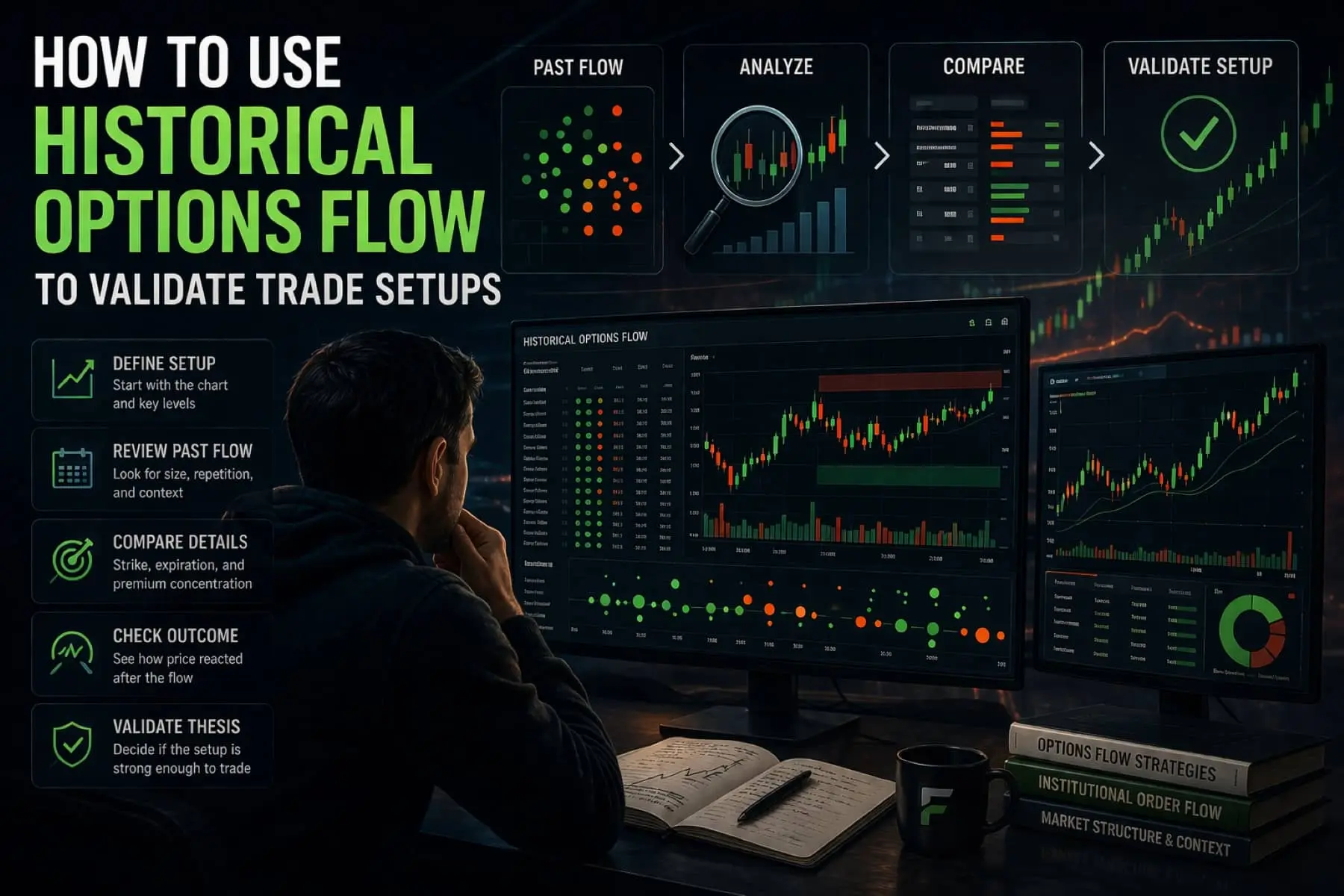
Historical options flow helps traders validate trade setups by showing whether prior institutional activity supports the idea behind a move. A chart can show structure, momentum, and key levels, but it cannot show whether meaningful options activity appeared around those areas before price reacted.
That is where archived flow becomes useful. By reviewing past options activity, traders can evaluate whether large premium, repeated sweeps, strike selection, expiration choice, and price reaction support the current setup. Used correctly, historical flow is not about copying old prints. It is about testing whether a trade idea has real context behind it before risking capital.
Why historical options flow matters
Real-time alerts get attention because they feel urgent, but urgency alone does not create a strong trade setup. Historical options flow adds the missing context by showing whether similar activity appeared before, how it developed, and whether price actually respected it.
One large order rarely tells the full story. What matters more is whether activity repeated near the same strike, whether premium concentrated around a clear thesis, and whether the underlying later confirmed that positioning. A strong options flow strategy does not stop at “someone bought calls.” It asks where the activity happened, how serious it looked, and whether the market responded.
What archived flow can reveal that a chart alone cannot
Charts show where price moved. Flow adds another layer by showing how traders were actually positioned around that move.
When you study past options activity, you can often spot details that improve decision quality. Repeated sweeps into the same strike before a breakout, premium building across several expirations instead of one lottery-style trade, or large put buying into resistance that price failed to reclaim all give the chart more context. It will not confirm every setup, but it does make it easier to tell whether the flow supports the chart or not.
What archived flow cannot do
Historical flow can improve context, but it cannot replace a trade plan. A large print may be part of a hedge, spread, closing transaction, or dealer-related adjustment. It also cannot fix a weak chart, poor timing, or bad risk management.
The archive should be used to pressure-test a setup, not to justify one after the fact. If the chart is unclear, the catalyst is weak, or the flow does not align with the thesis, historical activity should lower conviction rather than create false confidence.
Start with the chart, then use flow to pressure-test the idea
Start with price action. Build the setup first, then use the archive to decide whether it is strong enough to risk capital.
A practical sequence looks like this:
- Define the level or pattern on the chart.
- Identify the catalyst or market condition that could matter.
- Identify the catalyst or market condition that could matter.
- Compare strike selection, expiration, and premium concentration.
- Decide whether the flow supports the original thesis or weakens it.
The order matters more than most traders think. If you start with random prints and then go looking for a chart pattern to support them, you are usually forcing the trade. If you start with a chart and then use historical options flow to test your conviction, you are acting more like an analyst than a gambler.
For traders who want that comparison layer, Flowtopia’s Historical Dashboard is positioned around reviewing prior activity and backtesting trade ideas before entry.

What to look for inside the archive
You do not need to turn every archive review into a deep forensic exercise.
Before drilling into contract-level detail, focus on four questions. Did meaningful size appear? Was it repeated? Was it aligned with the chart? Did price respond after the flow showed up?
Repeated interest at the same strike or zone
One isolated trade can be noise. What usually stands out is repetition, especially when the same strike keeps attracting premium across multiple sessions around the same technical area. That usually deserves more attention than one sudden burst of activity.
This is where Real Time Options Flow and an archive complement each other. The live view shows what is developing now; the archive tells you whether that behavior has shown up before in the same area.
Expiration choice and urgency
Short-dated flow can be highly aggressive, but it can also be noisy. Longer-dated positioning may carry less urgency, yet it often gives a cleaner read on intent.
If traders were repeatedly paying up for near-term contracts right under resistance, that can support a fast-move thesis. If they were building further out while price held a base, that can point to patience rather than immediacy. Either way, the archive helps traders validate trade setups against the time horizon implied by the flow.
Premium concentration versus random activity
Premium is often what separates casual activity from serious capital. Scattered small prints do not carry the same message as concentrated premium into one thesis area.
Flowtopia’s broader product framing emphasizes filtering meaningful trades and reducing noise, which fits this exact use case. Serious flow analysis depends on cutting down random activity so the important behavior is easier to evaluate.
Whether price respected the positioning
This is where many traders stop too early. They notice the size but never follow through to see how price responded afterward.
Did the stock break the level soon after? Did it fail despite the flow? Did volatility expand in the expected direction? The archive is valuable because it lets you compare the order flow with the actual outcome. That is what tells you whether the old flow is worth respecting or whether it was just noise in hindsight.
A practical framework for setup validation
At its core, the archive helps you evaluate a setup with more context before putting money at risk.
Here is a usable review framework:
- Thesis first: define the trade idea before looking at the archive.
- Location second: check whether the flow appeared at a meaningful technical area.
- Structure third: review strike, expiration, premium, and whether activity repeated.
- Outcome last: examine how price behaved after the flow appeared.
That structure makes the process more reliable by forcing traders to connect positioning to actual market behavior instead of treating prints as standalone signals.
Example: breakout setup near a major resistance level
Assume a stock is pressing into a level it has failed at twice in the last three months. Volume is improving, and earnings are two weeks away. On the chart alone, the setup looks interesting but incomplete.
Pull up historical options flow and notice that on the prior failed pushes, call buying showed up late and faded quickly. This time, however, you see repeated call premium building for two sessions at strikes slightly above resistance, with expirations that cover the earnings window. That does not guarantee the breakout, but it does improve the quality of the read.
In that case, the archived tape helps because the current structure is not just similar on the chart; it is stronger in positioning terms than the prior failures were.
Example: bearish reversal that looks good on price but weak in flow
Flip the situation. A stock runs hard into a prior supply zone and prints a rejection candle. Many traders will short that chart immediately.
But the archive shows little meaningful put activity at the level. Worse, the recent tape shows prior put buying in that name was often early and wrong, while bullish premium kept returning on dips. That does not automatically kill the short idea, but it should lower conviction and probably lead to tighter risk controls.
This is exactly why past options activity matters. Sometimes the archive does not confirm the setup. That negative read is just as valuable as confirmation.

Tools that improve the read instead of replacing it
Archived flow works better when it is paired with adjacent context tools rather than used in isolation.
If you are looking at a setup in Flowtopia, there are natural companion pages worth using in the same workflow: the Wave Indicator for broader smart-money pressure, GEX (Gamma Exposure) for dealer positioning, and the Contract Tape for execution detail. Those tools reflect the platform’s own positioning around context, not just raw alerts.
That kind of cross-check matters because trade selection tends to improve when flow, positioning, and market structure all support the same idea. When they are not, the trade often deserves smaller size or more patience.
Common mistakes when using historical options flow
Historical flow is useful, but only when traders stay selective. The biggest mistake is using the archive to confirm a trade they already want to take instead of using it to challenge the setup.
Common mistakes include:
- Assuming every large print reflects directional conviction.
- Ignoring whether similar flow actually worked in the past.
- Looking at premium size without checking strike, expiration, and timing.
- Treating old flow as relevant even when price structure has changed.
- Using historical options flow to justify weak setups instead of filtering them out.
The archive works best as a decision filter. If the tape does not support the setup, traders should not manufacture a story around it.
Final take
Historical options flow is most valuable when it helps traders decide whether a setup actually deserves risk. It lets traders compare a current idea with prior positioning, premium concentration, contract behavior, and price reaction.
The best workflow is simple: start with the chart, review archived flow, compare the contract details, study the outcome, and then decide whether the setup is strong enough to trade. Used this way, historical flow helps traders validate trade setups instead of letting one flashy alert make the decision for them.
A disciplined historical flow process does not replace judgment. It improves it.
Similar Blog You
May Like
Understand how institutional money moves and turn complex options data into clear, actionable insights in real time.


Join traders using real-time options flow, institutional data, and advanced tools to make faster, more informed decisions.