

Blog Details

What Is Real-Time Options Flow? Explained for Traders - Flowtopia
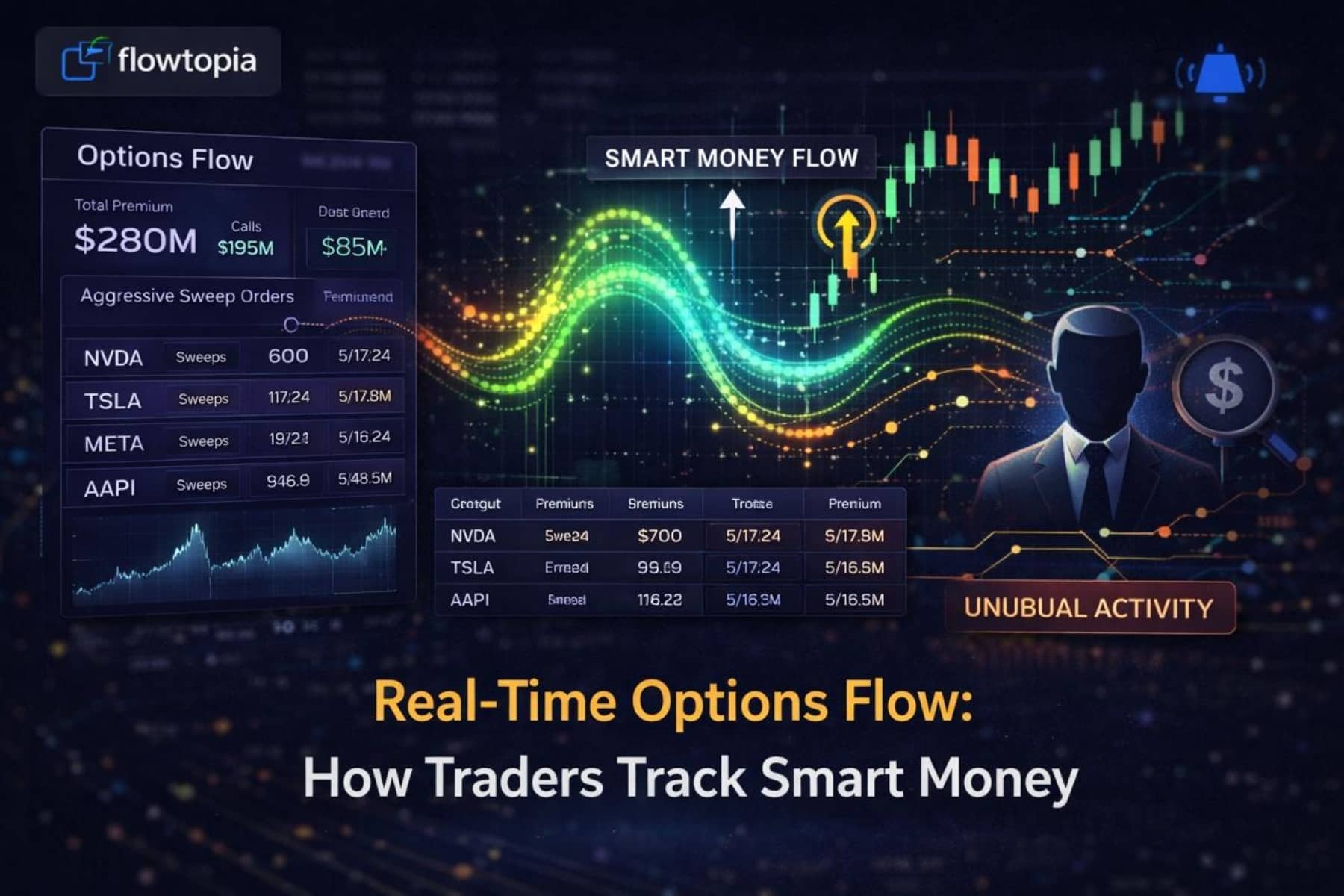
Financial markets move fast and by the time price reflects new information, much of the positioning behind that move has already taken place.
While charts and technical indicators help explain past price behavior, they don’t always reveal how capital is actively moving in real time.
This is where real-time options flow becomes increasingly important.
By tracking options transactions as they occur, traders can gain additional insight into how market participants especially larger players are positioning themselves beneath the surface.
What Is Real-Time Options Flow?
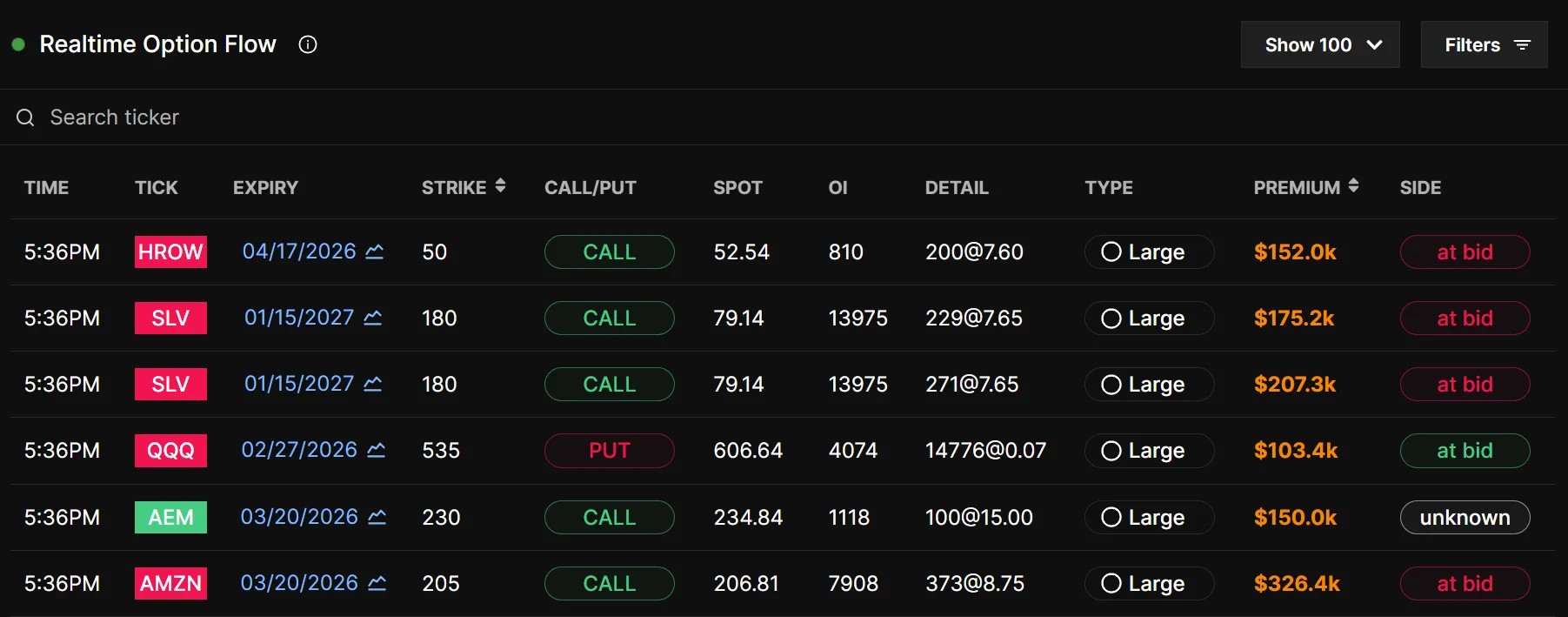
Real-time options flow refers to the continuous stream of options trades as they are executed across the market.
Instead of looking only at price, this data allows traders to observe how positions are being built in real time offering additional context about market behavior.
Each transaction includes key data points that help traders better understand positioning and activity.
Key Components of Options Flow Data
Options flow data typically includes:
- Underlying asset: the stock or index the contract is based on.
- Strike price and expiration: where and when the position is targeted.
- Trade size and execution level: how large the trade is and how aggressively it was executed.
This data updates continuously, allowing traders to track how activity evolves throughout the trading session.
How Traders Interpret Options Trade Activity
For instance, if a cluster of relatively large trades appears around a specific strike price within a short period, it may suggest increased attention at that level. In some cases, traders interpret this as a sign of positioning, although the intent behind the trades is not always clear.
It is important to recognize that options transactions are often part of more complex strategies. A large trade could represent a hedge, a spread, or a volatility position rather than a directional view.
Why Options Flow Data Matters
Price reflects the outcome of trading but not always the intent behind it.
Options flow helps provide that missing context by showing how capital may be moving before or during price changes.
By analyzing this activity, traders may identify areas where positioning appears concentrated across the market.
Identifying Key Market Levels
For example, repeated trades at certain strike prices or expiration dates might suggest that those levels are receiving more attention. In some situations, these areas may later coincide with changes in liquidity or volatility, although this relationship is not always consistent.
Importance of Repeated Patterns
Rather than relying on a single trade, experienced traders often look for patterns. When similar activity appears multiple times, it may provide stronger context than isolated transactions.
This is why options flow tracking is often used as a complementary tool. It does not replace traditional analysis but adds another layer of insight that can help traders interpret market behavior more effectively.
How Traders Use Real-Time Options Flow
Most traders don’t rely on a single data point.
Instead, they observe how activity develops over time and across multiple contracts to build a clearer picture of market positioning.
Unusual Options Activity
One way traders approach this is by monitoring unusual options activity. If the volume of a contract appears significantly higher than what is typically observed, it may indicate increased participation. However, this alone does not confirm intent.
Trade Clustering Patterns
Another approach involves identifying clusters of trades. When multiple transactions occur within a short time frame at similar strike levels, it may suggest repeated positioning. In some cases, this could be associated with institutional participation, although this is not guaranteed.
Execution Signals
Execution data is also important because it may offer clues about how aggressively positions are being entered. Trades executed closer to the ask price may reflect more aggressive positioning, while trades near the bid might indicate a different type of activity. Still, these signals are not always definitive and should be interpreted cautiously.
To gain a clearer view of these patterns, traders often use analytics platforms that aggregate and structure options flow data into a format that is easier to analyze.
What Is Smart Money Options Flow?
Smart money options flow is based on the view that institutional traders may have certain advantages, including more sophisticated strategies and access to larger pools of capital.
Institutional Trade Behavior
Because institutional trades are often larger, they can sometimes be identified within options flow data. This has led some traders to attempt to follow these trades in order to gain insight into potential market direction.
However, this approach requires caution.
Multiple Strategy Interpretations
Large options trades can represent a range of strategies, including:
- hedging existing positions
- speculative exposure
- volatility-based positioning
Because of this, a trade that appears directional may not necessarily reflect a clear market view. It could be part of a broader strategy that includes multiple positions.
For this reason, smart money options flow is generally interpreted as contextual information. It may provide insight into how capital is being allocated, but it does not offer reliable predictions on its own.
A Practical Example of Options Flow in Context
To better understand how options flow may appear in real market conditions, consider a scenario involving a widely traded asset such as the S&P 500 ETF (SPY).
Activity Around Key Levels
During economic announcements or earnings weeks, options activity may become noticeably heavier. Traders might observe a higher concentration of trades around certain strike prices, particularly those near the current market level.
For example, if SPY is trading near a round number, such as 500, there may be increased activity around that strike. In some cases, clusters of options trades may appear at that level over a short period of time.
Interpreting Market Reaction
Some traders interpret this type of activity as an indication that the level is attracting attention. Occasionally, it may coincide with short-term price stabilization or increased volatility. However, this relationship is not consistent and depends on multiple factors.
Market conditions, liquidity, and broader sentiment all play a role. A similar pattern may appear on one day and have little impact on another.
Overall, this shows that options flow is better used as supporting context rather than a standalone signal.
How Traders Interpret Options Flow in Practice
In practice, traders often interpret options flow by combining multiple observations rather than relying on a single signal.
A basic framework for reading options flow might look like this:
First, a trader may scan for unusual activity across different contracts to identify areas where volume appears elevated.
Next, they might look for repeated trades at similar strike prices or expiration dates to determine whether activity is consistent.
Finally, they may compare this information with price behavior and broader market conditions to see whether any alignment exists.
This process is not mechanical, and different traders may interpret the same data differently. Over time, experience plays a significant role in understanding which patterns may be more relevant.
While this approach does not guarantee outcomes, it may help traders develop a more structured way of analyzing derivatives activity.
Limitations of Options Flow Tracking
Despite its potential benefits, options flow analysis has several limitations. One of the primary challenges is incomplete information. Many options trades are part of multi-leg strategies, meaning that a single transaction does not reveal the full position. To better interpret individual trades, some traders refer to real-time contract feeds such as https://flowtopia.co/features/contract-tape.
Another major challenge comes from interpretation. Options data can be complex, and without sufficient experience, it can be difficult to distinguish between meaningful activity and noise.
There is also the issue of variability. Market conditions can change quickly, and patterns that appear significant in one context may not have the same relevance in another.
Because of these factors, options flow is generally most effective when used alongside other analytical tools rather than as a standalone method.
.jpg)
Real-Time Options Flow vs Traditional Analysis
Traditional analysis focuses on historical price data, using indicators and chart patterns to interpret market behavior.
Real-time options flow offers a different perspective by focusing on current positioning. It allows traders to observe how capital may be moving before those movements are fully reflected in price.
This doesn’t mean one approach is better, since each offers a different kind of insight.
Many traders combine both methods, using price action to confirm broader trends while using options flow to gain additional context about positioning.
When Real-Time Options Flow May Be Most Useful
Options flow analysis may become more relevant during periods of increased activity, when participation from larger traders is more visible.
This can occur during:
- earnings announcements
- major economic releases
- periods of elevated volatility
During these times, patterns in options flow may become easier to identify. Traders may observe increased activity across multiple strike prices or expiration dates, which can provide additional context about market behavior.
While these patterns do not guarantee outcomes, they may help highlight areas of interest.
Conclusion
Real-time options flow offers a different way to understand how markets operate by focusing on positioning rather than just price.
While it does not provide certainty, it can reveal how capital is being deployed beneath the surface, offering context that traditional analysis alone may miss.
For traders navigating fast-moving markets, combining price action with options flow may lead to a more complete and structured view of market behavior.
Similar Blog You
May Like
Understand how institutional money moves and turn complex options data into clear, actionable insights in real time.


Join traders using real-time options flow, institutional data, and advanced tools to make faster, more informed decisions.