

Blog Details

Options Sweep vs Block Trade: Reading Institutional Intent - Flowtopia
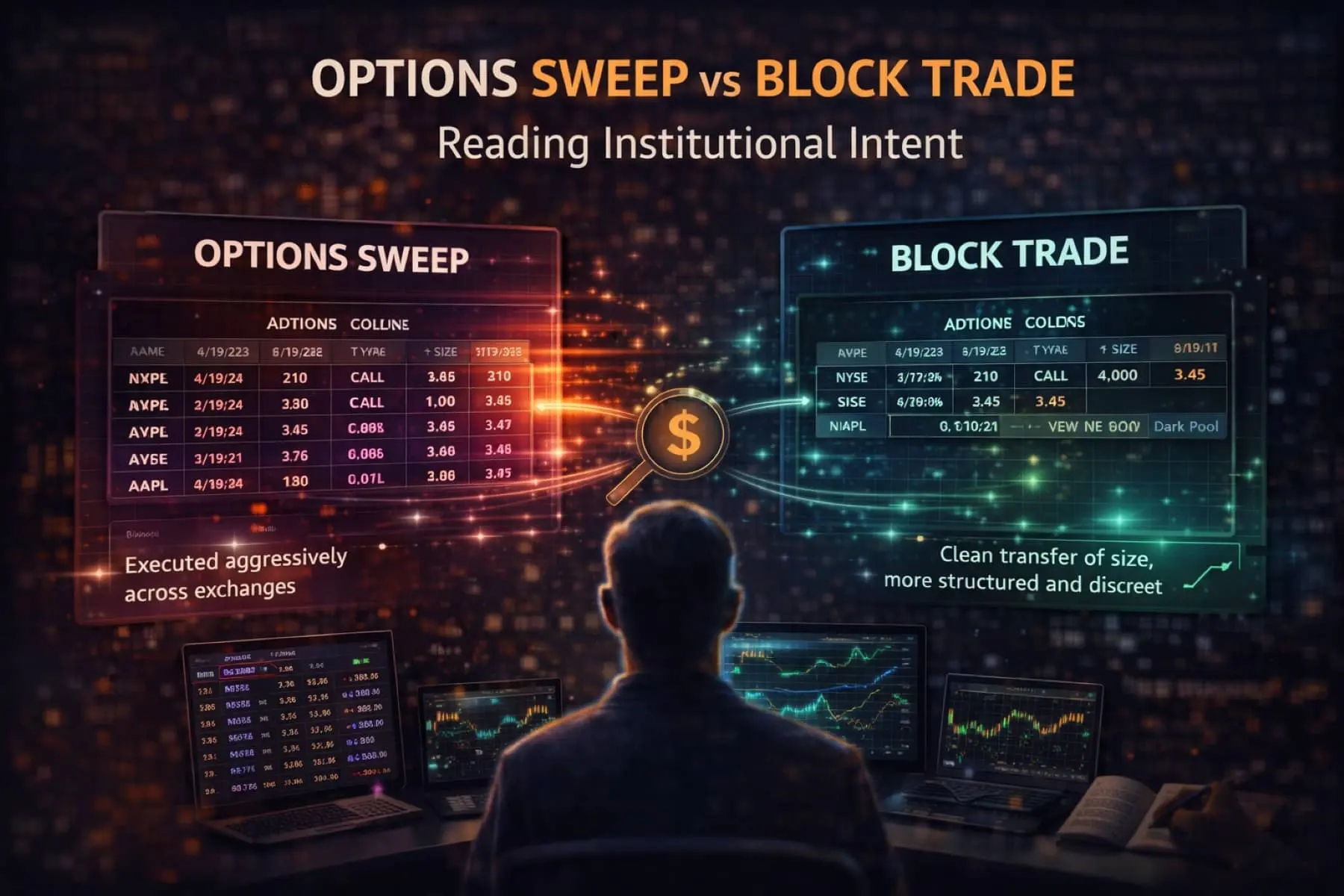
Big premium gets attention, but execution explains motive. Two trades can hit the same ticker, same expiration, and similar size yet carry very different information. That is why options sweep vs block trade is a useful lens for any trader trying to read institutional behavior rather than just react to large prints.
That philosophy is reflected throughout Flowtopia’s educational content and product structure. The platform is built around real-time options flow, contract-level visibility, historical review, and supporting tools such as GEX so traders can interpret smart-money activity with more structure and less noise. Its messaging consistently emphasizes clarity, execution detail, and disciplined analysis instead of hype.
At a practical level, the distinction is simple. A sweep usually tells you speed mattered. A block usually tells you size transfer and cleaner pricing mattered. The trade itself is not the signal. The execution choice is one part of the evidence.
Options Sweep vs Block Trade: Quick Answer
The core difference between an options sweep and a block trade comes down to execution priority.
Options sweeps are executed aggressively across multiple exchanges to get filled as fast as possible.
They often signal urgency and willingness to accept worse pricing.
Block trades are typically executed as a single, large transaction with more controlled pricing.
They usually reflect size transfer, discretion, or structured positioning.
In simple terms:
Sweep = speed and urgency
Block = size and control
Neither is automatically bullish or bearish. The real signal comes from how the trade fits into market context, timing, and repeated activity.
Why execution type matters more than raw premium
Most newer flow traders focus on the headline: how much premium went through, how many contracts printed, whether the trade looks unusual. That helps, but it misses the part that often separates urgency from slower positioning.
Flowtopia’s real-time flow Feature approach the task in a practical way: surfacing notable activity, comparing repeated prints, and adding context before assuming intent.
When traders search options sweep vs block trade, they are usually trying to answer a practical question: should this order change how I read the next move? The answer depends less on size alone and more on how the order reached the tape.
What matters most right away
Three questions usually improve the first read:
- Did the trader appear to prioritize immediate fill or controlled execution?
- Is the order part of repeated activity at the same strike or expiration?
- Does the print line up with structure, volatility, or an obvious catalyst?
Those questions matter because aggressive sweeps and negotiated blocks tend to communicate different priorities, even before you get into bullish or bearish interpretation.
What a sweep usually tells you
A sweep is generally a large, speed-first order routed aggressively across multiple venues so it can consume available liquidity quickly, often across several exchanges at once.
That does not guarantee informed flow. It does, however, suggest that the participant was willing to accept less favorable pricing to secure the position now. In flow reading, that is meaningful, especially when the tape stays active after the first burst.
The practical read on options sweeps
When options sweeps show up, traders should focus on how the order behaved, not just the label attached to it. Did it burst across venues within seconds? Did it lift the ask repeatedly? Did similar prints keep coming after the first order? Did price lag the flow, or had the move already started? Those questions matter more than the headline premium because they help separate genuine aggression from a single eye-catching print.
A sweep becomes more meaningful when it appears before an event, during volatility expansion, or in repeated clusters within the same contract family. This is why experienced traders place more weight on repeated contract flow and execution behavior rather than reacting to isolated prints.
What a block usually tells you
A block trade is usually understood as a large, often negotiated transaction executed as a single print or cleaner size transfer, where the participant prioritizes size and price control over immediate public execution and reduced market impact. That is why block trades in options should not be treated as automatic momentum signals. A block can represent opening interest, but it can also reflect a hedge, a roll, inventory transfer, or a structured position that is less urgent than traders assume.
What block trades in options may imply
When block trades in options hit the tape, a trader should usually consider a narrower set of interpretations first:
- size was important enough that cleaner execution mattered.
- the participant may have wanted discretion more than immediacy.
- the position could be strategic, hedged, or longer-horizon rather than a near-term push.
This is also where contract-level detail and historical comparison matter. Flowtopia’s broader product set includes contract tape, historical review, and contextual tools that help traders study how large positions were built instead of relying on premium size alone.

Options Sweep vs Block Trade in the real world
The simplest way to frame options sweep vs block trade is by asking what the trader optimized first. Sweeps usually optimize speed. Blocks usually optimize size transfer, cleaner pricing, or reduced footprint.
That is useful, but it is still not enough. Traders lose money when they turn the label into the thesis. The label only tells you where to start. A same-week call sweep into a breakout attempt can mean something very different from a large three-month put block printed quietly in the middle of a range. One may be expressing urgency around a near-term move. The other may be inventory transfer, a hedge, or a slower expression that needs more evidence before it becomes actionable.
Speed versus discretion
The real comparison in sweep orders vs block trades comes down to trade-offs. A trader placing a sweep is often accepting a more aggressive and visible execution style. The participant placing a block is often accepting more deliberate execution in exchange for cleaner size. As a result, sweeps are often more relevant for short-term momentum or catalyst anticipation, while blocks usually need more follow-up before you can reasonably infer urgency. Neither one should overrule price action, volatility, or broader market structure.
That distinction is why options sweep vs block trade matters more than many traders realize. It helps prevent a common mistake: assuming large capital automatically means immediate directional conviction.
How to read intent instead of just labeling order type
Once you understand the definitions, the real work begins. The goal is not just to learn the terminology, but to understand intent through execution and then test that view against market context.
A large same-week sweep into a clean technical breakout may deserve fast attention. A large longer-dated block in the middle of a range may deserve patience. The wrong habit is treating both trades as equal just because the premium is large.
A practical checklist for sweep orders vs block trades
When comparing sweep orders vs block trades, work through a few filters before deciding the print matters:
- check execution side and whether the order was truly aggressive.
- compare current volume with existing open interest.
- note time to expiration and whether the trade is short-dated or far out.
- ask whether the order confirms, leads, or contradicts current price structure.
This is also where broader context tools help. Flowtopia’s ecosystem is built around the idea that traders should combine live flow with structured tools and educational frameworks. Instead of relying on isolated data points, this approach encourages traders to connect real-time activity with broader patterns, helping them interpret how positioning develops across different market conditions.
Where traders misread the tape
The most common error is overconfidence. Traders see aggressive prints and decide they have found “smart money” without asking what kind of position was actually being built.
With options sweeps, the mistake is assuming that urgency guarantees correctness, even though it often does not. A rushed trader can still be wrong, early, or part of a hedge. With large negotiated blocks, the mistake is assuming size guarantees importance. It does not. Some large prints are meaningful; others are simply part of structured positioning or routine transfer activity.
A second mistake is skipping the surrounding context. Dealer positioning, nearby levels, event timing, and repeat flow all matter. Flowtopia explicitly positions tools like GEX and contract-level review as complementary ways to add that missing context rather than letting one large print dominate the entire read.
Final take
The real value in options sweep vs block trade is that it forces a better question. The better question is not “Was the order large?” but “Why was it executed this way?” That shift alone improves how traders read institutional activity.
Sweeps often point to urgency. Blocks often point to controlled size transfer. Neither is a standalone trigger. The sharper read comes from combining execution style with price structure, expiration, repeated activity, and market context. That is also why options sweep vs block trade remains one of the most useful distinctions in options flow analysis.
A more reliable way to read intent is to start with execution type, then move from label to context and confirmation. That approach is far more durable than chasing every outlier print, and it reflects a more disciplined framework for interpreting options flow.
Similar Blog You
May Like
Understand how institutional money moves and turn complex options data into clear, actionable insights in real time.

Join traders using real-time options flow, institutional data, and advanced tools to make faster, more informed decisions.