

Blog Details

Quad Witching 2026: All Four Dates + the June Shift
Quad Witching 2026: All Four Dates
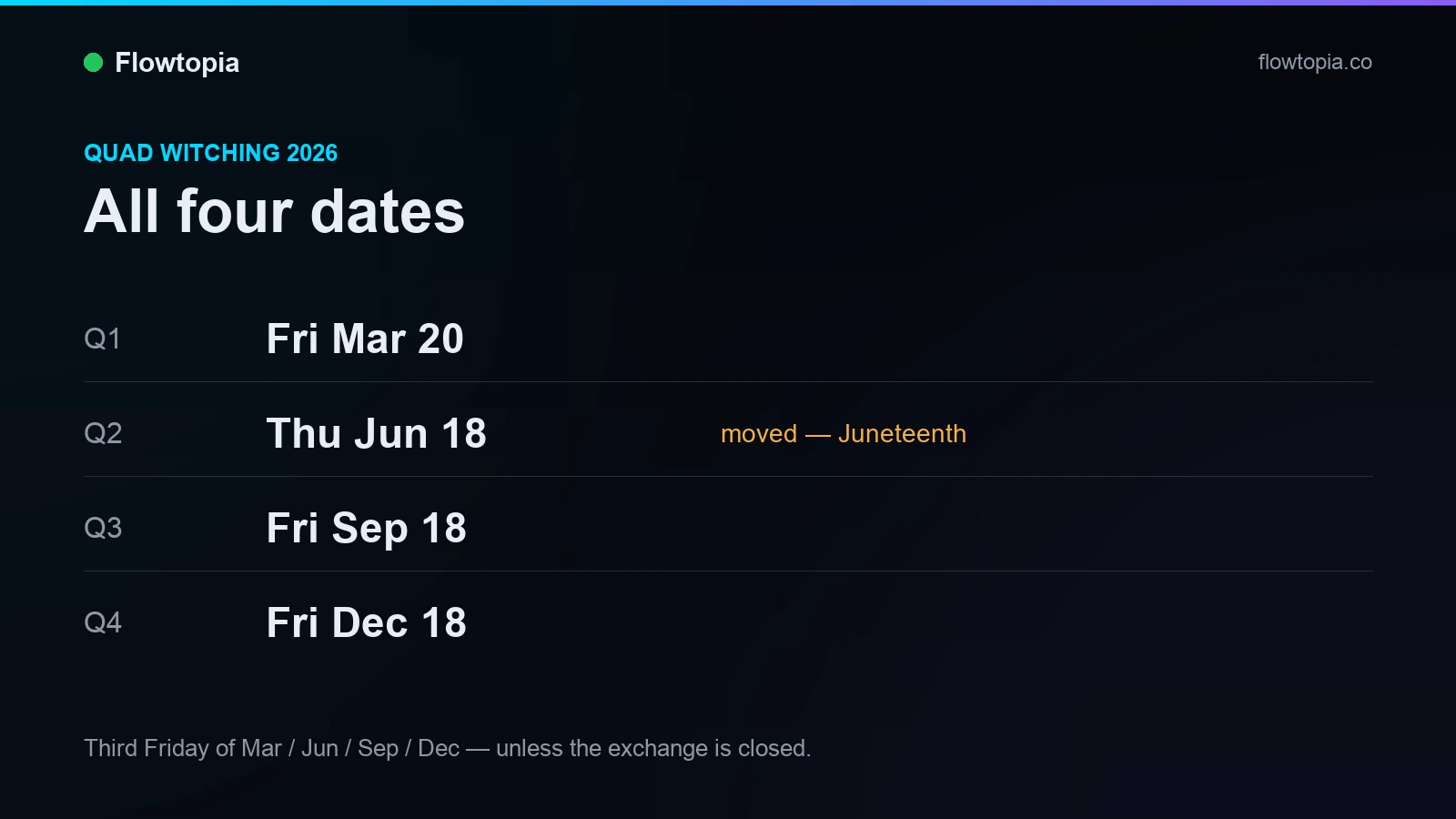
Quad witching in 2026 falls on Friday March 20, Thursday June 18, Friday September 18 and Friday December 18. Three of the four land on the normal third Friday of the quarter-ending month. June is the exception: it moves back one day to Thursday, June 18, because the third Friday — June 19 — is Juneteenth, an NYSE full-day closure. If a calendar you're reading says "June 19, 2026," it hasn't applied the holiday rule.
What are the quad witching dates in 2026?
| Quarter | Date | Day | Notes |
|---|---|---|---|
| Q1 | March 20, 2026 | Friday | Standard third Friday |
| Q2 | June 18, 2026 | Thursday | Shifted back one day — June 19 is Juneteenth (NYSE closed) |
| Q3 | September 18, 2026 | Friday | Standard third Friday |
| Q4 | December 18, 2026 | Friday | Standard third Friday |
Looking ahead, 2027 has the same quirk: quad witching is March 19, Thursday June 17, September 17 and December 17 — June again moves to Thursday because Juneteenth (Saturday, June 19, 2027) is observed by the NYSE on Friday, June 18.
What is quad witching?
Quad witching is the day each quarter when four classes of derivatives expire in the same session: stock index futures, stock index options, single-stock options and single-stock futures. It happens on the third Friday of March, June, September and December.
One honest footnote most pages skip: single-stock futures no longer trade on a U.S. exchange, so a purist would call today's event triple witching. The desk vocabulary never caught up, and "quad witching" is still what traders, brokers and financial media say — which is why it's also what people search.
Why does quad witching cause a volume spike?
Because four expiration cycles collide in one session, and each one forces a decision:
- Positions must be rolled, closed or exercised. Every open contract that expires that day has to be dealt with before the bell, which concentrates a quarter's worth of housekeeping into a few hours.
- Index rebalancing often lands the same week. S&P and other index reconstitutions are frequently scheduled around the quarterly expiry, adding large, price-insensitive index-fund order flow.
- Dealer hedges unwind at once. Market makers who are short options carry offsetting stock hedges. When those options expire, the hedge is no longer needed, and the unwind hits the tape.
- The morning and the close do the heavy lifting. AM-settled index options (SPX and friends) settle off Friday's opening prints; equity options settle at the close. That splits the day into two distinct pressure points rather than one.
Historically, quad witching sessions print the heaviest volume of the quarter. What that volume means for direction is a separate question — high volume is not a signal by itself, and expiry-driven flow is often mechanical rather than a view on the underlying. Treat the date as a volatility and liquidity event, not a forecast.
How is quad witching different from regular monthly OpEx?
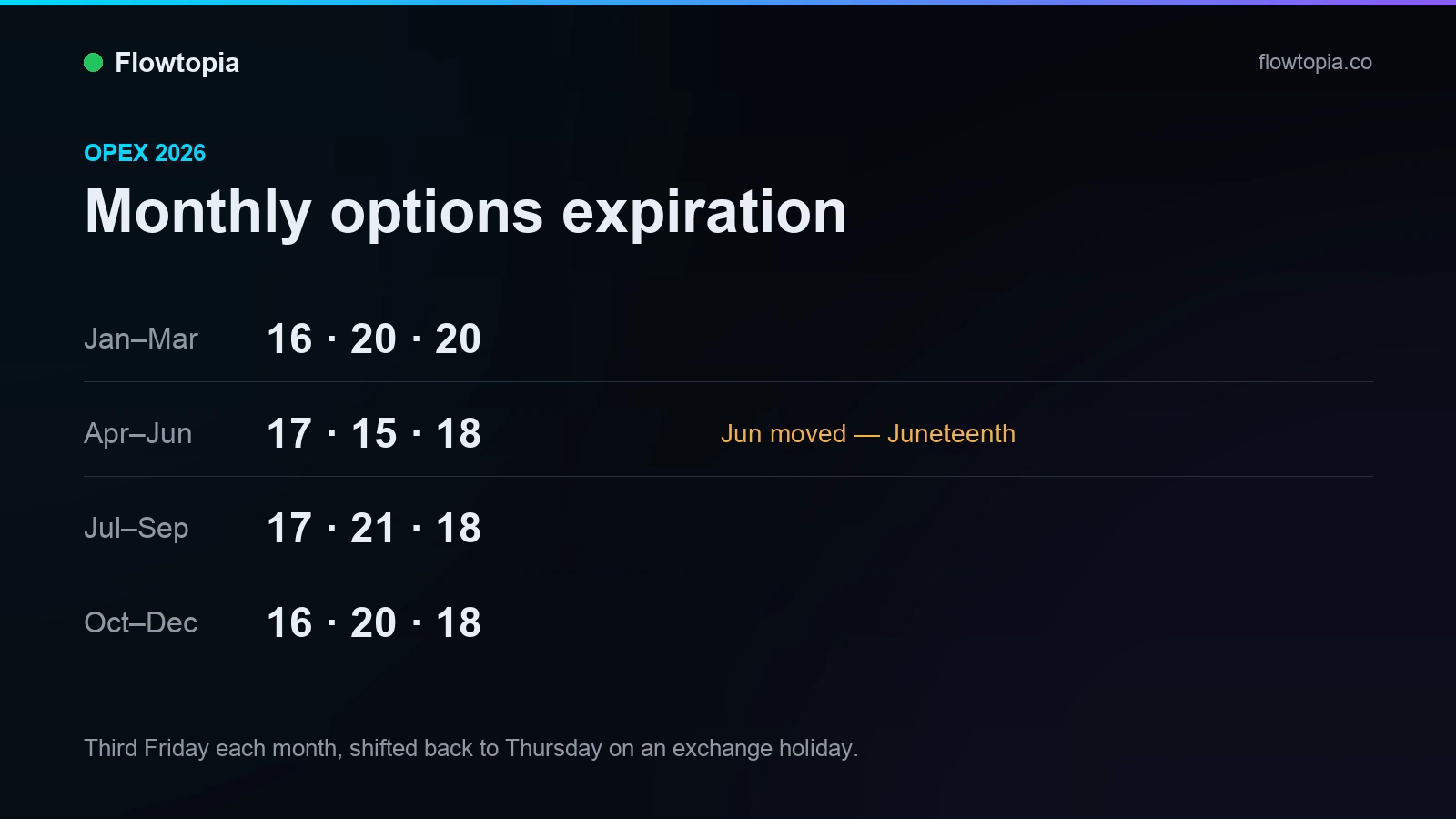
Every month has an options expiration ("OpEx") on the third Friday. Quad witching is the four times a year that the monthly expiry coincides with the quarterly futures expiry, so the notional rolling off is far larger.
| Monthly OpEx | Quad witching | |
|---|---|---|
| Frequency | 12x per year | 4x per year (Mar/Jun/Sep/Dec) |
| What expires | Equity + index options | Equity + index options + index futures + single-stock futures |
| Typical volume | Elevated | Heaviest sessions of the quarter |
| Index rebalance overlap | Occasional | Frequent |
The full 2026 monthly schedule is on our options expiration calendar.
Why does the June 2026 date move to Thursday?
The rule is simple and it's the part calendars get wrong: when the third Friday is an exchange holiday, expiration moves back to the preceding Thursday. It does not move forward to Monday.
June 19, 2026 is a Friday and it is Juneteenth National Independence Day — a full-day NYSE closure. So the entire expiration complex for June 2026 shifts to Thursday, June 18: the last trading day for expiring contracts, the AM settlement for index options, the close-of-day settlement for equity options, and the volume that comes with all of it.
Practical consequences for that week:
- Thursday, June 18 behaves like a Friday — expect the expiry-day character on Thursday.
- Friday, June 19 is a market holiday: no trading, no flow, no data.
- Any "expiry week" plan anchored to Friday is off by a day.
Flowtopia computes this rather than typing it in. The holiday shift is applied automatically, so the platform's calendar shows Thursday, June 18 without anyone having to remember.
How do traders actually use quad witching dates?
Not as a trade signal — as context. Knowing the date changes how you read everything else:
- Positioning going in. Where is open interest stacked? Gamma exposure by strike behaves differently when a huge slice of that OI is about to disappear.
- What's real vs. what's mechanical. A large sweep on an expiring contract two days before quad witching is usually not the same story as the same sweep in a contract with 60 days left.
- The morning after. Once expiring open interest rolls off, dealer hedging constraints reset — which is why the session following a big expiry is watched almost as closely as the expiry itself.
- Calendar collisions. Quad witching weeks often overlap with an FOMC decision or a major CPI print. Two scheduled volatility events in the same week is a different environment than either one alone.
None of that tells you what a market will do. It tells you what's mechanically happening underneath the tape, so you're not surprised by it.
Where can I track quad witching alongside everything else?
The four 2026 dates are already built into Flowtopia's News & Calendar page, next to the economic calendar (impact-rated, filterable by currency, with Actual/Forecast/Previous on every release) and the Most Anticipated Earnings board. Expiry dates sit in the same view as the CPI, FOMC and earnings events they collide with — including the Thursday, June 18 shift, computed, not hand-entered.
Alongside it, the WAVE — Flowtopia's flagship indicator — plots cumulative signed call vs. put premium through the session against SPY, which is exactly the kind of read that gets distorted and then reset around a large expiry. Membership is $45/month, $350/year (≈$29/mo, saving $190 vs. monthly) or $1,500 lifetime.
Flowtopia is a market-data and education platform. Nothing here is investment advice or a recommendation to buy or sell any security. Options involve substantial risk and are not suitable for every investor.
FAQ
When is quad witching in 2026? March 20, 2026; Thursday, June 18, 2026; September 18, 2026; and December 18, 2026. June is the only one that isn't a Friday.
Why is June 2026 quad witching on a Thursday? The third Friday of June 2026 is June 19, which is Juneteenth — a full-day NYSE holiday. When the third Friday is an exchange holiday, expiration moves back to the preceding Thursday, so the June 2026 expiry is Thursday, June 18.
Is it called quad witching or triple witching? Both are in use. "Quad" refers to four expiring instrument types including single-stock futures, which no longer trade on a U.S. exchange — so the event is technically triple witching today. Traders and financial media still overwhelmingly say quad witching.
Does quad witching mean the market goes up or down? Neither. It is a volume and volatility event driven largely by mechanical rolling, settlement and hedge unwinds. Elevated volume on an expiry day is not a directional signal, and treating it as one is a common mistake.
How is quad witching different from monthly OpEx? Monthly OpEx happens 12 times a year and covers equity and index options. Quad witching is the four quarterly expirations where index futures and single-stock futures expire alongside them, so far more notional rolls off in a single session.
What are the quad witching dates for 2027? March 19, Thursday June 17, September 17 and December 17, 2027. June shifts to Thursday again, because Juneteenth 2027 falls on a Saturday and the NYSE observes it on Friday, June 18. Dates beyond 2027 depend on the NYSE holiday calendar being published for those years — we publish them once they're confirmed rather than projecting them.
Similar Blog You
May Like
Understand how institutional money moves and turn complex options data into clear, actionable insights in real time.



Join traders using real-time options flow, institutional data, and advanced tools to make faster, more informed decisions.